PRESERVING THE PERSONALITY

Defining the personality shows us mental illness is really a functional adaptation that safeguards one's evaluative integrity. An individual's ability to evaluate his environment effectively and confidently from his individual capacities and faculties is his biological purpose. How we evaluate and understand information reflects outwardly as our personality. Anxiety happens when one's evaluative mechanisms are compromised or threatened. Every individual evaluates differently, so standards of "normal" personality development cannot be utilized to diagnose so-called personality disorders. When we require our children to make sense of information in ways that make sense to our capacities and faculties, we compromise and threaten their evaluative integrity. Biologically purposeful adaptations that look to an observer like mental illness are easy to prevent....

Monday, October 5, 2015

Destabilization + Humiliation= Marginalization + Rage: What Can Educators Do To Change This Equation?

It is hard to imagine our playful, spirited children gradually becoming permanently filled with rage and vengeance by the time they reach 20 something. It is even harder to imagine our curiosity seeking children, full of ideas and the excitement of their own personal what-ifs, gradually becoming vengeful enough to take up arms, walk into a school, and start shooting.
When we have a mass shooter, we pore over their history, their interests, their backgrounds, so we can profile them and add to our knowledge for how to spot future potential mass shooters.
Here is one similarity I am sure the mass shooters have probably all shared, but nobody has every looked for it. If you are a boy and you understand and interact differently with information and people in your environment, you are harder to teach in the classroom setting with traditional methods, so you are put on a behavior plan or subjected to some form of behaviorism in an attempt to make your responses and behaviors appear more like those of the other kids.
Molding a child’s responses and behaviors to be different than they are is not an innocent attempt to ‘help’ the child. Behavior management is a destabilizing and disorienting practice we need to re-evaluate for how and why it is done.
When you push back on a child for how he responds or behaves, you destabilize the integrity and coordination of his sensory, motor, and nervous systems. The destabilization that occurs to the kids on behavior plans day after day and year after year has the potential to be extremely destructive to their mental integrity and stability.
There are many internal dynamics that become destabilized when you have your responses and behaviors managed by other people. If you are an atypical learner, you interpret and understand cause and effect differently than the majority. You interpret spatial, temporal, and numerical information differently. You often have an atypical kind of visual acuity, depth perception, and eye-hand coordination. Often your receptive and expressive language is different than the norm. In light of this, you will consistently and constantly reach different kinds of conclusions and make different kinds of predictions for what to do in any given context than the majority.
When you think differently, you present different kinds of behaviors that reflect your capabilities for interpretation and intellectual organization. None of us can divorce our interpretations, thoughts, or our intellect from our behaviors. They work together and depend upon one another. They are a team.
Our human interpretations, conclusions, predictions, responses, and behaviors don’t magically generate from a vacuum inside of us that we can magically tweak and change according to the whims of our parents, teachers, friends, or anyone. Our brain is busy every moment we are awake handling the data points all around us and organizing those data points in ways we are cognitively able to do so.
When a boy who has a very atypical sensory, motor, and cognitive set of capacities with which to generate perceptions, thoughts, responses, and behaviors, these dynamics are all going to present quite atypically. Does this mean they are wrong and need to be modified or changed?
Unfortunately, in the classroom setting, often boys seem in the wrong when they present different responses or behaviors than most of the other kids. The responses and behaviors of these boys, instead of being seen as integral to how their nervous system is able to sense and process information, are seen as disruptive and inappropriate.
So, teachers, specialists, and counselors have one single option with which to manage and change the responses and behaviors of these boys. And that is with some sort of behavior plan. We rely on behavior plans for two reasons. First, they are the only option available to us as educators. And second, they are the only option available to us as educators.
This is why I can be so certain the mass shooters have been subjected to some sort of behaviorism. Behavior plans are perfect for educators because we are taught explicitly how, when, and allegedly why to use them. They are concrete, easy to implement, and give teachers a way to be accountable for ‘helping’ who they have been taught to view as behaviorally challenged instead of cognitively different.
Behavior plans look and sound good on paper. In reality, they are humiliating, destabilizing, and rage producing. Behavior plans are no different than corporal punishment. The brain responds to physical pain in the same way it responds to all discrepancies from what it was predicting. The brain responds to discrepancies from what it was expecting by cueing for anxiety. Anxiety destabilizes us in order to get our full attention so we can take steps to stabilize ourselves.
When we have the control over how to register and manage our anxiety, and stabilize the destabilizing occurrences that happen to us, it is no big deal. For example, if we sit on a tack, we quickly stand up. Problem solved. When we raise our hand and answer a math problem and are told we have the wrong answer, we have a quick shot of anxiety due to the discrepancy, but quickly see our error and manage our anxiety. When we prepare to buy pizza for lunch but find out the school cafeteria made a last minute change and is serving meat load instead, we have a shot of anxiety, but quickly readjust our expectations in order to manage the anxiety. This dynamic involving our brain making predictions for what will happen next and then cueing for anxiety when there is a discrepancy is what our latest brain research tells us happens all day long. But we have not reassessed our psychological explanations for human behavior to account for any new brain research.
Therefore, Anthony B., who has a brain that connects up differently from his peers, will suffer. We will not take into consideration the differences in Anthony B.’s brain connectivity and his nervous system because we still rely upon outdated psychological strategies for how to understand and manage this boy. We will use destabilization as a strategy for getting him to respond and behave the ways in which we want him to. This is cruel and unusual, particularly because the children routinely subjected to the most forms of behaviorism year after year are the children with the most easily destabilized nervous systems.
Anthony B. doesn’t have quite as much cognitive flexibility as his peers even though he is quite intelligent. He has trouble envisioning more than one solution to problems. So if a discrepancy occurs, he responds with more intense anxiety than his peers.
Once Anthony B. makes a prediction, he has trouble cognitively formulating new predictions to adjust for the discrepancies because he usually has fewer options that come to mind, and it takes him longer to arrive at alternative predictions and solutions because he processes information more slowly than his peers. For this reason, Anthony B. has more heightened anxiety responses when discrepancies happen, and his process for working through anxiety takes longer. While working through his anxiety, Anthony B. often needs to express exactly what is bothering him in any given context and why. Anthony B. can problem solve eventually, but it takes him much longer and his process isn’t quiet or neat or tidy.
Is it easier to let Anthony B. whine and complain for a minute or so when the cafeteria runs out of pizza and replaces it with meat loaf or is it easier to immediately threaten him with no recess if he complains too loudly or too long?
Well, it is way easier to threaten him with no recess. Mrs. Anderson has 25 kids in line. She believes, if every one of them went on and on about how upset they were about the meat loaf replacement, all chaos would break loose. So, she can’t let Anthony B. make a big stink.
Or can she? Robert Sapolsky, Stanford professor and one of the world’s leading neuroscientists says, “Often the biggest impediment to scientific progress is what we know, not what we don’t know.” What we ‘know’ from psychological theories is that children have to be able to roll with disappointment and the unexpected to be ‘normally’ adjusted. So when children don’t roll with the unexpected, educators are taught in psychology courses to take away a reward or apply a negative consequence to teach students how to adequately roll with the unexpected. Psychology courses teach us to compare childhood behaviors to standards of normal instead of thinking about each child as having a unique nervous system that manifests according to that child’s cognitive, sensory, motor, and nervous system idiosyncrasies.
If each child has a uniquely calibrated nervous system, then we can’t really identify what is a normal response and what is not. If we allow children to respond as they respond and stop expecting them to respond according to ‘psychologically normal’ ways, then we will stop constantly and artificially destabilizing their nervous systems.
Trying to micro-manage Anthony B.’s whining and complaining responses and behaviors to normalize them as compared to the other kids sounds good on paper and seems reasonable in practice. But if behaviorism really worked, teaching and parenting would be the easiest job in the world and we would be able to eliminate all the behaviors we are not fond of by the time a child reaches 2nd grade. If behaviorism really worked, we truly could produce designer children like Skinner thought we could. We could decide exactly how we want children to behave, manipulate positive and negative reinforcements, and then voila, perfectly normally behaving children would pop out everywhere.
Well behaviorism doesn’t work like this, and we know this, but we still use it as if it has been a scientifically verified practice. Behaviorism can work short term the same as corporal punishment can work short term. Whether we destabilize our children in order to coerce them to behave in certain ways through paddling, verbal reprimands, taking rewards away, or assigning negative consequences makes no difference to their nervous system. Destabilization is destabilization. It is always unpleasant and it is handled the same way by the brain regardless of how it occurs.
We can easily compile and massage statistics to show behavior plans are successful. We can just as easily show how corporal punishment can be successful. Destabilization works well for manipulating all mammals. Just because we can do it, does it mean we should do it?
For a majority of all children, we could do anything to them and they will learn successfully in spite of what we do. They have flexible and adaptable brains and bodies and can manage the constant destabilization and anxiety that behaviorism causes. It won’t be pleasant for them, but they can manage. Some children will not fare so well with any sort of behaviorism and the anxiety will eat away at them. They will develop hidden or not so hidden anxiety related problems. And some will grow up with unmanageable amounts of rage.
Even though many of our students appear to be un-phased from having their responses and behaviors commented upon throughout their school years for how appropriate or inappropriate they were, our statistics for ever increasing amounts of mental illness, addiction, and depression imply otherwise.
What if we just change how we understand the role destabilization and anxiety play in our nervous systems and factor these roles into how we understand and treat the behaviors of our students? Every single student in school is going to manage what they are predicting to what is actually happening slightly differently due to how they are cognitively able to understand information and make predictions. Every single student is going to have different amounts of destabilizing anxiety when their predictions are challenged. Every single student is going to express and work through their anxiety in different ways and at different speeds.
So when Anthony B. starts to cry and complain about the meat loaf, is it really that important to shoot him an angry glance and tell him if he doesn’t quiet down he will not be allowed to go on recess?
The Anthony B.’s of this world make different kinds of predictions and therefore present different kinds of behaviors than the majority. The Anthony B.’s are the boys for whom anxiety is more heightened and more troubling than their peers. The Anthony B.’s take longer to express and work through their anxiety. Because of this, they are the boys put on behavior plans to squelch their whining and complaining. Given they already have heightened amounts of anxiety that takes longer for them to work through, their responses to having their anxiety processing time aborted and replaced with negative consequences are going to also be heightened. The super heightened anxiety will quickly move into rage. What if the ability of the Anthony B.’s to understand, express and manage their anxiety becomes so twisted and warped due to these behavior plans that they begin to associate anxiety immediately with rage instead of anxiety abatement? What if these boys become the mass shooters?
What if all we had to do was reverse our position on behavior plans and behaviorism to decrease the destabilization and humiliation that leads to marginalization and unabated rage? What if we start to believe that the destabilizing anxiety, degradation, and pain of being paddled is the exact same as the destabilizing anxiety, degradation, and pain of having one’s behaviors managed?
The formula for changing the equation of destabilization plus humiliation equaling marginalization and rage is to simply treat the expressions and the behaviors of our students as valid, legitimate, and important. When Anthony B. has a fit when the meat loaf is replacing the pizza, what if we take him seriously and treat his disappointment as completely valid instead of trying to make him appear more normal?
What if we replace the very negative and demeaning psychological verbiage of throwing a fit or having a temper tantrum, with the term destabilizing anxiety. We can have much more patience for a child we believe is suffering from destabilizing anxiety than we can a child we believe is throwing a fit or having a temper tantrum.
Here is an example of how to help a child work through destabilizing anxiety. “Anthony B., I am so sorry for this last minute change from pizza to meat loaf. I know how much you love pizza and that meat loaf is not your favorite. I can understand why you are so upset with this last minute change. Let’s ask the cooks when they will be having pizza next.”
Anthony B. is still upset, but much less so because he can see you are working with him and not against him. His anxiety is not disregarded or criticized, but taken seriously. If this kind of approach is always taken with Anthony B., he will be able to understand and manage his anxiety as a matter or course like all the other kids. He will likely become more upset more frequently than the others due to his unique nervous system, but if he eventually works through his anxiety whenever he has it, what the heck? Why not work with his nervous system instead of against it. As he matures, he will become more efficient at working through the unexpected. If we work against his nervous system with behaviorism, however, he will never learn how to manage HIS personal nervous system on his terms, and he will become a walking time bomb waiting to go off.
Working with the nervous systems of our students is not what we educators learn about in psychology courses. We learn to identify appropriate responses and behaviors and how to elicit them. And we learn to identify inappropriate responses and behaviors and how to extinguish them.
Behaviors are highly integrated parts of a child’s capacities to sense, perceive, think, emote, and predict. There is no possible way to disentangle these dynamics from one another. Messing with a child’s behaviors is like pulling one wire from a car engine and expecting the engine to still run. We have much more understanding and patience for the integral nature of machines than we do our human nervous systems.
Messing with a child’s behaviors to achieve ideal or expected sorts of responses during school is an idea we can easily dispose of. If we could begin to work with the nervous systems of our students the way they are, instead of how we want them to be, we will find our classrooms become much calmer and easier to manage than they do when we use behaviorism of any sort.
It becomes clearer every day, every month, every year, and every decade that psychology does not have effective and reliable theories or strategies to help us understand or prevent the overwhelming anxiety and rage that leads to unadulterated violence and mental suffering. Our psychological theories are inadequate at best, harm-causing at worst.
We need new ideas. We need new theories. We can do better.
I believe we should heed Robert Sapolsky’s warning. “Often, the biggest impediment to scientific progress is not what we don’t know, but what we do know.”
What we think we know about our alleged human psychology is quite likely working against us, not for us. Our psychological explanations for human behaviors rely upon degrading, dehumanizing, and contradictory descriptions and verbiage. Psychological explanations for human behaviors were initially accepted without ever having been subjected to the scientific method. At this point, psychological explanations have been around for so long that nobody remembers how the ideas came about in the first place and nobody has yet bothered to double check them for accuracy and scientific validity.
Because all biological and neuroscience disciplines rely upon the foundational concepts of psychology to base all of their brain and behavioral related understandings and research, the inaccuracies, if they do exist, are woven deeply into the fabric of everything we think we ‘know’ about human thought, emotions, perceptions, and behavior.
I know we can do better. To do better, we need to take what we think we know from psychology and put that knowing on a shelf, let it rest out of sight for a bit, and try out some new ideas for how to understand and care for the developing brains of our children.
Children are not mannequins. Current psychological theories, when applied, treat children as if they are. Psychological theories believe we can look at behaviors separately from the whole child and tweak them however we want to ‘help’ our students learn to comply normally with school expectations.
Psychology teaches us we have to build the concept it has randomly and unscientifically identified as a character in each human child by expecting appropriate, normal, and moral behaviors from each child. Building character sounds great on paper. But the simplistic and fanciful notion of a character is an inaccurate way to understand and treat the highly integrated and complex nervous systems of our students.
Our students need to learn how to make optimal decisions as often as possible in as many different contexts as they might come across throughout their lives. Helping them maximize their abilities to organize information and develop skills to help them assess, conclude, and predict in the ways that can be successful for their cognitive capacities does not have to ever include the mystical entity we like to call a character.
If we treat the nervous systems of each child as important and valid and normal for who they are cognitively, sensorially, and motorically, then we will treat the responses and behaviors of our children as important and valid. We will stop viewing behaviors as having the capacity to be disordered or abnormal because this would no longer make logical sense.
Nobody has abnormal behavior from their own perspective and trying to convince a child or anyone their behavior is abnormal is rage inducing. Helping a child achieve a learning goal in a way that makes sense to the child does not require managing the child’s behavior, it requires managing the learning environment to match the child’s sensory, motor, and cognitive capacities.
If we change how we understand anxiety responses and behaviors of our children, we can change the equation for how we respond to their behaviors. (Behaviors + Responses)-(Destabilization + Humiliation) = Calm Nervous Systems. Nervous systems, to be calm, must be allowed to process the disruptions that occur to them in the ways that make sense to them. Artificially messing with this process for our own desired effects is cruel and unusual and causes some children to grow into adults with unmanageable amounts of anxiety and rage.

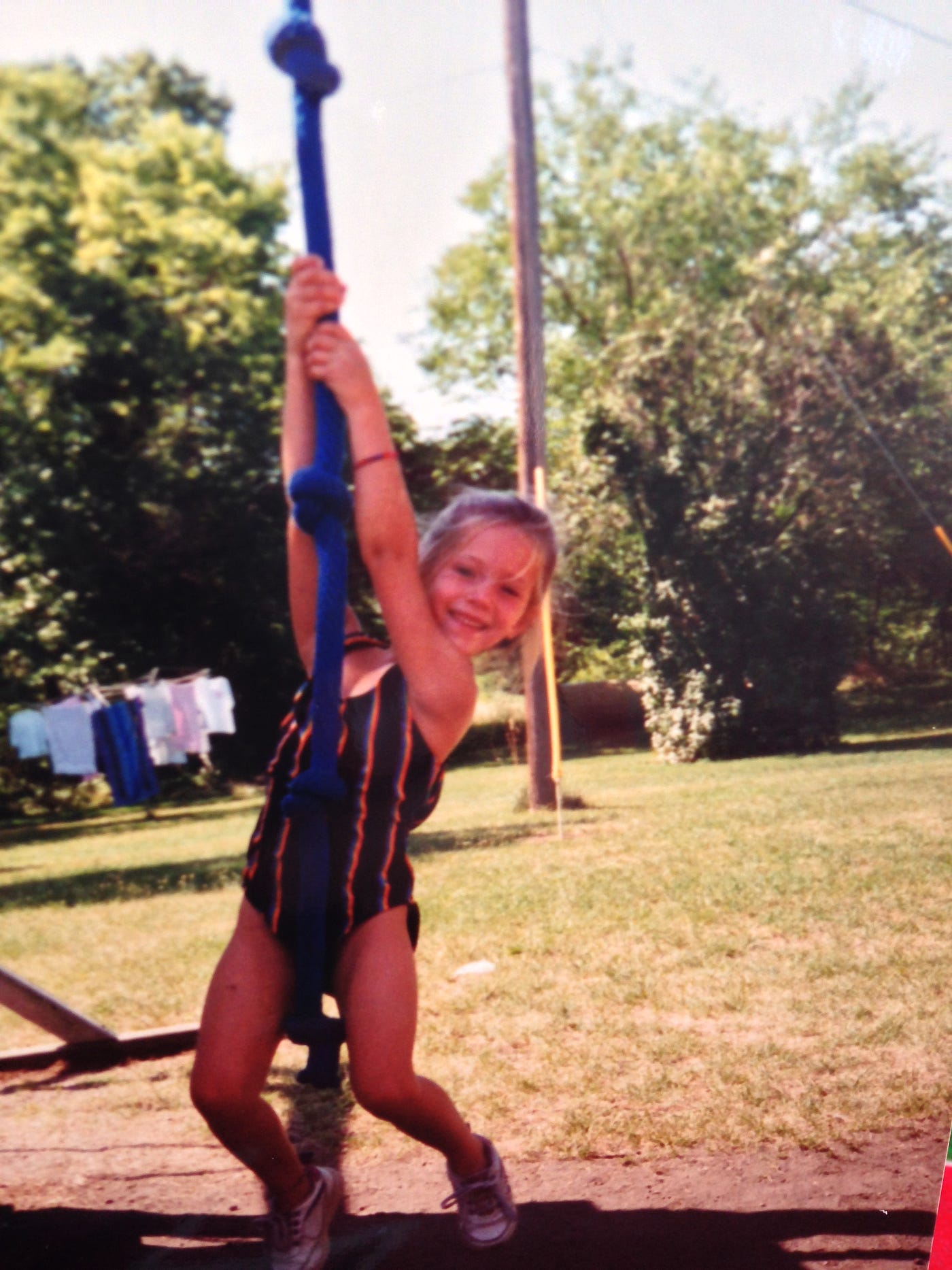
Monday, August 10, 2015

Is It Time To Apply a New Paradigm for How to Understand and Interpret Human Behaviors?

My daughter pictured above was a gymnast pretty much since she could walk. She wanted to climb up and jump off everything when she was 4 and still does at 24. To be jumping, swinging, flipping, or climbing delighted her. It is easy for us adults to identify and associate these gross motor behaviors as pleasing to our children.
What about all the rest of our children’s behaviors? What are they and what kind of relationship do our children’s brains have to their behaviors? What could be more important to the well-being of our children than to get the relationship that exists between their brain and their behaviors right? Our children cannot have fulfilling relationships with others or grow up and lead fulfilling lives unless their brain and their behaviors are optimally integrated and functional.
If you ascribe to the same theory of the brain that Jeff Hawkins does, which I do, then you believe behavior is a by-product of prediction because his research shows our brain is an organ of memory and prediction. The human brain builds invariant representations, or models, of everything it learns, then stores these models to be recalled as needed in making predictions for what to do next.
Jeff Hawkins believes if we want to understand what our brain does and what intelligence is, we must understand the nature of our predictions and how the cortex makes them. To understand how our brain makes predictions, we must consider what is happening neuronally, but just as importantly, we must consider the role our human behaviors play in allowing for and supporting the predictions our brain has made, is making, and will make. This essay is focusing on the roles our behaviors play in the memory/prediction matrix that is our brain.
In effect, our behaviors are the expression of our neuronal activity and any action we are capable of is a human behavior. To a large extent, our brain relies upon our behaviors to do its heavy lifting. Our behaviors allow our brain to orient itself in space and time so it can collect the relevant sensory information it needs to make predictions for what is likely to happen in the next moment and what an optimal response should then be in a repeating fashion.
Imagine a child is about to cross the street. His brain must be able to predict when to cross. To do this, his brain must cue his neck muscles to turn left, then right, in order to position his eyes properly so they can see the oncoming traffic. If someone restricts his neck muscles, his brain will cue for an extreme anxiety response because his brain cannot orient his eyes properly to predict whether or not cars are barreling towards him.
Our brain has anxiety, paranoia, and fear whenever any of our behaviors are restricted because our brain relies upon the full array of human behaviors available to us to know it can optimally meet any situation that might arise.Much of our brain’s job is to be ever vigilant for the unexpected. If a teacher tries to manage our behaviors, we become anxious, paranoid, and afraid because, in effect, the teacher is limiting the full range of behaviors we can access should the unexpected occur.
Handcuffing a human makes him exceedingly anxious and vulnerable. Our human brain will cue for an anxiety response when we are handcuffed against our will because the handcuffs restrict the behavioral range our brain relies upon and depends upon. Putting a wristband around one wrist will not cause the brain to cue for an anxiety response because typically a wristband will not inhibit our behavioral range.
Handcuffing is an extreme behavioral limitation and it is easy to understand why it causes people great anxiety. However, nobody I know has yet made the following connection. Our brain has only 7 basic emotional cues it is able to deliver. It is not very differentiated in this regard. Consequently, our brain cues for the same emotional/physiological alarm signals for being handcuffed as it does for any behavioral limitation put on us. This means, if we are handcuffed or simply told we cannot suck our fingers during silent reading, our brain makes us feel equally anxious. All behavioral limitations cause our brain to cue for anxiety. Anxiety cues are the same for slight limitations as they are for extreme limitations because our brain, even though it can think millions of different thoughts, has only 7 emotional cues at its disposal.
If Amy is told she cannot suck her fingers during silent reading, her brain will become confused and disoriented because she will not be able to achieve the calming effects she predicted she could. This arbitrary limit to her behavioral range makes her brain feel threatened and it will cue for an anxiety response pretty equal to the anxiety response her brain would send if she was handcuffed. Our brain has one signal for anxiety and will send it out every time it perceives a limit to its ability to predict optimally. This is not rocket science, but it calls for us to change our current old fashioned and outdated methods of seeking to control and shape the behaviors of our children.
We absolutely must consider what our behavior management practices are doing to the physiological response systems inside of our children’s bodies, because anxiety related disorders are epidemic among our nation’s children. Once anxiety becomes unmanageable, a child’s brain is stuck in a double bind situation. Double binds often lead to full-blown mental illnesses.Is behavioral compliance worth setting our children up for anxiety related disorders, depression, rage, violence, and mental illness?
We teachers are trained to speak about the behaviors of children as if their behaviors exist for us to be able to judge them for how well they are performing in school. We objectify our students’ behaviors and talk about them as if we have some sort of ownership and say in what those behaviors should be.
Our current models for how children should behave are based upon ideals we have fabricated that say behaviors a, b, and c, allow for the important accomplishments, x, y, and z. Therefore, if children exhibit any other behaviors than a, b, or c, they will not accomplish x, y, or z and therefore they should be redirected or reprimanded until their behaviors fall into compliance. Like many of our psychological ideals, this sounds reasonable on paper. In practice, however, it is a recipe for anxiety, depression, rage, violence, and for the least cognitively flexible or our children it is a recipe for mental illness.
When you deeply consider the biological role our human behaviors play in our overall human functioning, you can’t help but question our current ideas and practices. The biological role of our human behaviors is to enable our brain to be our brain and to perform all the jobs it has to perform. Our brain does not take the inhibition or management of its array of behaviors by a third party lightly. As mentioned above, the brain registers extreme anxiety when somebody else wants to limit the behavioral tools in its tool kit of behaviors, regardless of how small or big that limitation is.
Is there a correlation between how cavalier we adults are about managing our children’s behaviors and the epidemic numbers of childhood anxiety related disorders? It seems highly likely.
Our current theories of human behavior from psychology, many of them handed down from over a century ago, have zero sensitivity towards the work our brain has to do. Our current theories of behavior pre-date modern brain research, but we rely upon them because we have never updated them.
A child’s brain doesn’t magically press the pause button on the jobs it is biologically required to do unceasingly when it is plunked in a classroom with a teacher who seeks to manage his or her behavioral range.Quite the opposite. The brain is largely an organ of paranoia and threat detection. It doesn’t mess around. It never takes behavioral limitations lightly. It will always be the organ that it is and do what it does, regardless of the limitations we try to place around it. And the more limits placed on it, the more anxious, paranoid, defensive, and hyped up it will become.
For a teacher to have a predetermined list of allowable behaviors in the classroom, again, sounds good on paper, but it is a disaster for the brains in that classroom. Sometimes our brain needs us to be able to jump up and turn around when we hear a loud noise coming from behind us. Sometimes our brain needs us to move as fast as we can to lift our hand off of a hot surface or to remove our body from a painful position.
Our brain itself cannot physically do the behaviors it needs in order to gather all the relevant sensory information it needs in order to make the assessments it needs in order to make the predictive decisions it needs in order to determine what to do next each and every moment, all day, every day. Our brain needs to know it can rely on its entire tool kit of behaviors every waking moment so it knows it can always optimally perform any job it might be called to do.
Our brain cannot simply ‘forget’ or put on hold that the unexpected always has the potential to occur and that it needs to be at the ready at all times to potentially make predictions for how to manage the unexpected. Our brain, to always be at the ready and to be fully operational at all times relies upon the full use of the full range of its behaviors.
Our current theories for how children ‘should’ behave do not take into consideration the work our brain has to do to be our brain, nor do they take into consideration the intense system of alarms our brain sets off every single time its behavioral range is inhibited for any reason. We must let our children exist from the brains they have, not the brains we believe they should have or want them to have.
In school there are 25 kids in a class, all with completely different idiosyncrasies within the structures and functions of their brains, different neuronal connections, different stored associations and memories, different speeds at which they can recall old information, different abilities to retain new information while recalling old information, different backgrounds, to name a few. Due to so many differences among all children, there is no way to predetermine the behaviors a child should exhibit while they are dealing with information they have never dealt with before in the classroom. It is counter productive to hyper focus on student behavior. No two brains are alike. No two sets of behaviors will be alike while new learning is taking place.
If you have spent any time with children, you will observe them become extremely skittish, anxious, defensive, angry, and/or paranoid when you attempt to manage their behaviors. If teachers put all their energy and focus into helping each student master the new learning in the ways that make the most sense to each child, and the teacher refrains from referencing student behaviors while doing so, her job will instantly become much easier. The kids will become much calmer. The learning will unfold organically for each child. And almost like magic, behavior problems will cease and desist.
When I connected the dots between how inseparable a child’s understanding is from his or her behaviors, I stopped referencing my students’ behaviors cold turkey. What happened was this. My students did not feel threatened. They did not feel anxious. If there was a conflict, they were able to pause and listen to me because they weren’t gearing up to defend themselves. More importantly, I was able to pause and listen to them because I stopped having anxiety about behaviors they exhibited that were different from what I was predicting. I stopped predicting what I believed their behaviors should be and instead put all of my focus on what the learning goals and methods should be. Teachers cannot magically turn off their brains when they teach. When things go differently than a teacher expects, she has anxiety. One way to reduce anxiety is to be more selective about the predictions you make. If you don’t predict how your students behave, you are never thrown into anxiety by their behaviors.
When I stopped discussing or referencing student behaviors for one full month, my classroom turned into calm city. I began to accomplish my teaching goals so much more effectively because my students became SO MUCH CALMER. This was a big deal because I taught all the children in my district from K through 12 who were often the least calm and the most behaviorally unpredictable. I realized different thinkers will exhibit different behaviors. There is no way I can predict how somebody who is differently abled than I am in all ways will either think through a situation or behave in that situation. By simply respecting my students’ boundaries instead of expecting them to understand and respect mine, teaching became easier than I ever imagined it could be.
Many people, when I discuss this new paradigm for understanding and interpreting behavior, believe I am proposing a student free-for-all where kids do whatever they want whenever they want. This couldn’t be further from the truth. With these new ideas I created learning environments that were much calmer and far less filled with chaotic and disruptive behaviors than ever before.
Furthermore, when I took the focus off of behavioral goals and put all of the focus on learning goals, I developed a whole new language with which to speak to my students. When student behaviors were no longer part of the learning equation that I had the right to manipulate, my students’ brains literally lit up for me. I could suddenly see into their brains and understand exactly how they assessed information and came to conclusions because I became so much more focus on the cognitive conclusions they were reaching rather than the behaviors they were exhibiting. I feel like I met each and every one of my students for the first time when I learned to interpret them through how they think and understand information instead of through how they behave.
My new rule of thumb is that every single human being’s behaviors are private, personal, and crucial to their sense of stability and safety. To reference another human beings behaviors can cause them to feel irritated, angry, embarrassed, ashamed, and/or violated. I try not to talk about or gossip about anyone’s behaviors any more when I am teaching or having professional or personal conversations. Certainly there are exceptions to every rule, but being considerate of the extremely personal and private nature of other people's behaviors has improved every single one of my personal and professional relationships, more ease, more joy, fewer conflicts. Conflicts that do arise are refreshingly easy to solve when solutions are the focus and not the behaviors of either party involved.
I am bursting at the seems for how exciting and successful I believe this new paradigm for how to understand human behaviors can be. In my opinion, it could be a real game changer. Its application makes teaching and life in general so much easier!

Friday, July 31, 2015

THE FIRST TIME IT HAPPENED....

The first time it happened I was elbow deep in dish suds having washed every dish from our finals ravaged house. It was the day before our college graduation ceremony. It was the day before all our families, including many of our grandmothers with delicate sensibilities were due to arrive. And it was about 8:00 pm.
My soon to be fiance, soon to be husband, and soon to be co-parent, Kevin, walked in the door and smiled at me. He had gone missing that whole day while I and my housemates scrubbed our dilapidated, well-worn college house from top to bottom.
We were a co-ed house, 4 men, 4 women. I hoped like anything this fact would not become evident to my very catholic, very old fashioned, beloved grandmother. She figured it out in a second, unfortunately, being just as smart as she was catholic.
Anyway, at the very least I could make sure our house of sin was clean. Plus everyone in the whole world knows you do not under any circumstance invite a whole bunch of mothers and grandmothers to your house without scrubbing it down from top to bottom, right??
So when my soon to be fiance sauntered in at 8:00 pm after I had been cleaning for hours and had settled into a good hour of dish washing as my last chore, I interpreted his pleasant smile as a smirk of smug satisfaction that said, “I managed to avoid the cleaning duties all day, haha…”
And the cleaning duties, I have to say, were terrible. Everyone knows how dirty college houses can get, particularly during finals. We were all interdisciplinary studies majors, a program requiring from us a big, huge, hairy senior project, the culmination of work we did since sophomores. We were knee deep in our projects up through finals week. Our moderate level of cleanliness went out the window the entire month.
All of us in this three story college funhouse had been cleaning all day except for Kevin. Three of the eight of us had bedrooms on the first floor, the main floor of the house, where the bulk of the living, studying, eating, and partying happened. The lucky three with rooms on the first floor were me, Annie, and Kevin. Annie and I, being reasonably clean people for 20 somethings, did a decent job of keeping the family room, kitchen, and downstairs bathroom reasonably clean and picked up all year.
The year was 1983. Feminism was definitely a part of our college manifesto, but it hadn’t seeped into our gender roles quite yet. The almost husband did not cook or clean all year. Not that what any of us did could entirely be called cooking, but we took turns putting things on plates that could be eaten.
Annie and I did a lion’s share of the cleaning on the first floor all year because we were super duper nice and because we had to live on it. Plus, Kevin had been elected Student Body President and was crazy busier than all of us put together. Annie and I did not make a big deal out of sharing the chores equally with Kevin and all that egalitarian jazz. We just did them.
It didn’t hurt I was head-over-heels in love with Kevin. Even in the advanced year of 1983, I came from pretty old fashioned stock where a woman did a lion’s share of the cooking and cleaning for the man she loved. Actually who am I kidding, the women did all of it. I took on the role of housekeeper and occasional mediocre food preparer without too much thought because when you have been raised by a tribe of intensely Irish Catholic women you cook and you clean, no questions asked.
I was still a card-carrying feminist, however, struggling to figure out how to translate theoretical feminism into practice. I was acutely aware on this last day before graduation, armed with all of my new feminist sensibilities, that Kevin could and should help us get our house cleaned up. He was done with his presidential duties, so not only should he help, he should also take this opportunity to show Annie and me how appreciative he was for all the cooking and cleaning we had done all year. We were still kicking it old school with the gender roles, but today we were going to be refreshingly modern by sharing equally in the housework.
Except Kevin never got the memo. Kevin had the exact same cultural heritage I did. He was and is the hardest working man I’ve ever known, but brought up as he was, cooking and cleaning was not something he ever had to developed organized thoughts about. Much the same way, I had no thoughts in my brain about the coaching strategies of the defensive coordinator of the 1982–83 Cleveland Browns.
Without organized thoughts about cooking and cleaning, Kevin was neither ungrateful or grateful about these matters. He would have been just as happy to live with dirt and eat whatever. I didn’t form thoughts about the defensive line of the Browns and he did not form thoughts about how often to sweep the kitchen floor.I did not see these distinctions at the time. So when Kevin went missing the day of the cleaning, my anger hit the fan.
You know the kind of rage you can feel towards your spouse after 15 years of marriage? I did not know anything about it yet. In fact, I was 100% clueless about the level of rage I would eventually feel towards this man in the years to come.
The first time it happened, the first time the rage came to me, even though still in its infant stages, was during this cleaning debacle. When Kevin walked in at 8pm after the work was all done I lit into him about how inconsiderate, ungrateful, and ridiculous he had been to disappear all day. (Cell phones hadn’t been invented yet.)
When I started yelling, Kevin was blindsided. I had never even so much as frowned at him. Throughout our senior year I had been the sweetest, most helpful, most adoring girlfriend a guy could have. And my sweetness and adoration were totally sincere. I loved him to distraction. My anger at him blindsided me as much as it did him.
This was the first of many times Kevin would provoke my anger and vice verse. Eventually, this guy I loved as much as one human could love another would provoke rages in me I could never have seen coming. This first time it happened was small potatoes, a walk in the park, child’s play. It resembled only a hint of my future rages. Neither of us had any idea what we were in for, what dark places our beautiful and intense love would lead us to…
When I finally stopped yelling at Kevin about the house cleaning in college, he had big crocodile tears slowly stream down his face. He quietly started pretending to find things to clean and straighten even though there was nothing left to clean or straighten. We made up and moved on, got engaged, got married, had a baby, then another, then another, then another. The love of my life and I would build a life together, climb the socioeconomic ladder together, deeply love and raise our 4 children together, but most of all, we would build all consuming rage towards one another, one incident at a time for 27 long years.
We never lost our intense love for one another, but our rage beat it to death. We tried every form of help and intervention in the known world to figure out why we precipitated so much rage at one another in the hopes of being able to stop it. We read everything we could get our hands on about psychology, relationships, and communication. We tried one psychological theory and personality theory after another we thought would help us. We went to one totally kind but unhelpful psychologist after another. We even delved into the world of alternative healing. Nothing made a dent. Nothing made our rage at one another stop. Quite the reverse. The harder we tried to stop it, the more it grew exponentially every passing year until we could no longer bear it.
We turned 50 in the year 2011. We still, despite all the raging for 27 straight years, loved one another as much as people can humanly love. We also had all the other necessary ingredients for a successful marriage in spades. We shared common interests, backgrounds, senses of humor, and ideas about childcare and money.
We wanted our relationship to work so badly, so very badly. But by year 27 we were exhausted by each other and we had exhausted every possible problem-solving option available to us. The field of psychology had nothing, zip, zero for us even though we methodically mined it for everything it has to offer the whole 27 years.
So at age 50, in the year 2011, we threw in the towel, a separation plan was hatched, and divorce lawyers were called. Exactly one day after calling my divorce lawyer, I was playing kickball outside on an 80 degree day. I was an Adaptive Physical Education Teacher for students with special needs at the time. During our break in play, I watched one of my 5th-grade students problem solve.
My student with all sorts of sensory and cognitive differences never once referenced anything or anyone outside of himself to identify his problem, assess his options, organize his thoughts, form a prediction for how to solve it, and then act on his predicted solution. My student did what made the utmost sense to his own personal sensory, motor, and nervous systems.
In solving his problem however, my student broke three school rules. I should have given him a consequence, but he changed my life for the better that day, saved my marriage, and caused me to reinterpret everything I had ever come to know about how to understand my own personal relationship to everyone and everything outside of me.
Simply put, there is me, my brain, and then there is everything else in the world that isn’t me. I call everyone and everything that isn’t me information. The only role I have to play in my existence is to continuously interpret the information around me in order to supply my brain with a continuous stream of predictions, or cues for what my brain and body should do next. When events unfold differently than I predict they will, my brain becomes alarmed in the exact same way my skin does when it encounters a hot curling iron. Both cues tell me something is amiss and I have to reorient to get my bearings. We rage if our hand is held onto a curling iron and we rage when we cannot make our predictions match up to our reality.
This is the skeleton of the biological theory of personality I downloaded into my brain that day after kickball. More importantly, I erased everything I had ever learned about how to interpret information and make predictions for what to do next directly and indirectly from the field of psychology, my childhood religion, yoga, Oprah Winfrey, crystals, aromatherapy, and the self-help industrial complex and started living my life from my own brain and body.
My whole life I had learned that my own personal physiological cues were to be controlled and pushed down, that they were mysterious forces to overcome, that my ego was always trying to assert itself, and that my unconscious mind was an elephant and I a mere hapless rider. Who knew this was a lie? I was in fact lit up with sensory, motor, emotional, and cognitive cues, to name a few, that were in me to help me respond to everything and everyone around me at all times in ways that made optimal sense to my own uniquely customized nervous system. I wasn’t filled with sabotaging states of subterfuge. I was filled with biological bells and whistles and super effective problem-solving cues. Who the heck knew?
My student knew, that’s who. He knew because he did not have the processing capacity, speed, or desire to learn how to interpret information and make decisions solely based upon how other people would judge the outcomes of his decisions. This would have seemed crazy to him, preposterous, and hysterical. My student would also never have thought to take his cues for how to organize information from the nervous systems of other people.
My student interpreted information in his environments the way humans are biologically set up to, with the aid and assistance of his own sensory, motor, and nervous systems. Due to his sensory and thinking differences, nobody had been able to teach this dynamic out of him. My student showed me how efficient and pleasing it is to be human by interpreting, organizing, and responding to information from the perspective of one’s own personal brain, body, and nervous system. He showed me how inefficient, ridiculous, and rage provoking it is to make my own personal decisions as if others had to emotionally and intellectually process them from inside of their own nervous systems in order to approve of them first. He showed me the absurdity of judging the decisions of other people by processing their decisions through my own nervous system in order to personally respond to their decisions as if I had been the one to make them in the first place.
Unlike my student I had learned since birth how to understand my own personal thinking capacities from the point of view of how others would interpret my thoughts and decisions. I did not rely upon my own physiological cues to guide me. I learned how to take cues for how to think and decide from the facial expressions, body language, and verbal responses other people directed at me before, during, and after my decision-making processes. As a result my brain was wired up to the world completely backward to what it should have been. The decision making parts of my brain were wired into everyone and everything else but me.
Until I observed my student I didn’t know interpreting information from my own personal nervous system was even possible. Actually that is not entirely accurate. I was existing from my own personal nervous system, but I was using cues for how to operate it mostly from external sources, those sources being the judgments and body language of other people, religious standards, feminist standards, psychological theories, self-help books, yoga, Oprah Winfrey, and a whole host of supposedly much wiser and ‘self aware’ people than myself.
The first 27 years of my marriage I had been expecting my husband to respond with his words, face, and body in the ways that jibed with my nervous system and vice verse. I was processing his nervous system output and he mine. Our backward orientation to our own nervous systems caused the destabilization which caused the rage. Problem solved. Case closed.
My new biological theory of personality takes a while to explain. It is straightforward and makes neurological sense and it involves unlearning many inaccurate ideas promoted and perpetuated by the field of psychology, religion, self help, yoga, etc. All these disciplines teach us how to develop a backward relationship to ourselves. They teach us how to understand ourselves by understanding the intellectual and emotional needs of other people and the rules of an ideology while simultaneously repressing our own emotional and physiological cues. All of these disciplines offer elaborate means of coping with ourselves due to the destabilization and anxiety that accompanies the backward orientation to the self they teach. Being super flexible mammals, many of us humans can get along reasonably well with a backward orientation to our own physiology, but it causes many stresses and strains, thus the need to constantly cope with therapy, yoga, prayer, and meditation, etc.
The application of my biological theory to my own life has made my life exquisitely pleasing to live. I don’t have to do the constant self-improvement and self-healing I use to as a matter of course.
The application of my biological theory of personality has enabled my husband and I to have the stable and loving relationship we wanted so badly. The fix was absurdly simple, completely a matter of properly understanding our human brain mechanics. We didn’t have to fix ourselves, we just had to understand how we work. We both work just fine, there was never anything wrong with us, or our relationship, we just had our physiological wires crossed.
Finally, when I figured out how to exist from my own nervous system instead of trying to repress it and ‘work’ on it with every form of self-help available to mankind, I felt like Helen Keller must have felt when she connected the dots between the finger spelling in her hand and representations of the world around her. She figured out how to explore, learn about, organize, and orient her own personal decision making capacities to the information all around her. She learned how to learn and thus she learned how to thrive. And that is exactly what happened to me. My student, however, was my teacher.
I write about my biological theory of personality daily in an effort to streamline it and craft it into something scientifically legitimate. My goal is to write a book with a thorough explanation.

Friday, July 24, 2015

MORE PSYCHOLOGICAL THERAPY NOT THE ANTIDOTE TO OVER-DRUGGING CHILDREN WHO UNDER-PERFORM IN THE CLASSROOM


As long as behaviors are the attributes we rely upon to diagnose and treat children for psychological disorders or personality disorders, we will over-prescribe drugs and we will subject children to way too much psychological therapy. We need a third option. A third option requires a new paradigm for how to understand human behavior in relationship to human cognition.
A third option focuses intently and intentionally on maintaining the mental health and overall integrity of a child’s brain and personality. The current vague and non-specific psychological theories of personality teachers are taught to apply in the classroom do not allow children to preserve the coordination and cohesiveness of their own unique sensory, motor, and nervous system capacities.
Micromanaging the behaviors of a human being via drugs and/or therapy will have grave negative consequences for that person’s capacities to understand and organize information and orient himself in space and time in the ways that make the most sense to him sensorially, motorically, and cognitively.
Human behaviors allow and support the brain in its task of sensing internal and external information, assessing that information, and then forming conclusions about that information in order to make decisions for what to do next. Behaviors do not occur independently of the brain’s directives, but the brain is constantly cueing for behaviors to help it assess future information it predicts it will need. For example, a child about to cross a street anticipates a car might be coming so his brain directs him to engage in the behavior of rotating his neck left and right to position his eyes so they can take in the view of the road in case a car is approaching.
All human behaviors serve a purpose and reflect how a human is CAPABLE of and is in fact understanding and managing the information present in any given moment. When adult authorities arbitrarily decide which behaviors are acceptable and which are not, it is the same as taking the pain sensors out of his skin. A child uses his pain sensors to orient safely in space. Individuals born without pain sensors suffer gruesome injuries their whole lives because they have no cues for how to safely orient their bodies in space.
An individual’s array of behaviors serve many purposes, one of which is to allow him to safely orient in space. We cannot pick and choose for a child the behaviors he can or cannot rely upon in any given situation. We must help children orient their brains and bodies in our classrooms and other group situations using methods that do not require us to constantly modify and comment on their behaviors.
All we have to do to successfully teach children is present information in ways they are CAPABLE of understanding it. We have thousands of ways of presenting information we can try before defaulting into behavior modification, or shipping the child off to therapy, or drugging him.
Gently helping children understand what to do next at all times instead of identifying them as disordered based upon their behaviors and putting them on behavior plans will eventually change the field of psychology from top to bottom someday and will dramatically decrease mental illness.
Ironically, the emergence of artificially intelligent machines might help us treat the developing brains of our children with more accurate and humane methodologies.
For example, if an instrument of AI was programmed to scan and interpret genetic information and was intermittently inaccurate, nobody would modify the machine’s output, it’s ‘final behaviors,’ they would modify the machine’s processing capacities to make sure the machine understood how to move from one piece of information to the next accurately.
Conversely, I am a teacher and we teachers are taught how to modify the output of our children, their final behaviors after they have already sensed, assessed, organized, and decided upon a whole string of information that resulted in their final behaviors. We teachers are taught precisely how to modify our students’ behaviors when they exhibit inaccurate output of any kind. We are taught much more explicitly how to modify their final behaviors than we are to consider how they arrived at those behaviors in the first place. Every child behaves for reasons that make sense to him and that are important to him. When we modify their output to suit our own goals for them, we disorient them, confuse them, anger them, and I believe lead many of them towards mental illnesses.
In the classroom setting, whenever a child goes off task, I have observed about half the teachers and teaching assistants will interpret the off-task behaviors as resulting from deliberate student defiance and stubbornness. These educators will then attempt to change the behavior of the child by giving the student a negative consequence or denying him a reward.
Modifying behaviors through drugs OR therapy are not evidenced based options with conclusive evidence for how they work, they are simply our only options thus far. Just because they are our only options does not make them our best options. Similarly, a large majority of children will learn regardless of how we teach them or whether or not we modify their behaviors, subject them to therapy, or give them drugs. Because some children will always learn despite what we do or don’t do to them does not mean existing options are optimal. If any of our existing methods of teaching and raising children were optimal, 1 in 4 of them would not end up mentally ill at some point in their lives or for their whole lives.
We teachers use a whole variety of behavior modification methods mostly by default. There are no theories of the human personality we can apply practically in the classroom that don’t involve behaviorism of some sort. We need a new biologically accurate theory of personality we can easily apply in our classrooms.
What if we focus on the unique manner in which each child senses information, organizes and orients to it, and then forms predictive decisions for what to do next with that information. Helping a child expand his ability to understand the information in his environment according to how we want him to can be a routine and easy task if we focus on the child’s understanding rather than his behavior.
Getting a child to have a specific relationship to any piece of information does not happen due to magic pills or magic behavior management plans. For a child to orient to information in specific ways he needs specific instructions for how to do so that MAKE SENSE TO HIM. Magic pills do not change how a child fundamentally senses, organizes, or orients to information. Just because a child is paying attention to information for longer amounts of time due to pills does not mean he is making sense of the information any better than he was before the pills. Forced behavioral changes do not equal better understanding of information. Forced behavioral changes lead to anger, rage, withdrawal, depression, anxiety, and/or mental illness.
Modifying a child’s ability to UNDERSTAND information in a specific way might require many attempts and many environmental adaptations but can be done. Modifying the child’s behaviors destroys the integrity of his sensory, motor, and nervous systems as they do their jobs of taking in, assessing, concluding, and deciding what to do next. Modifying and inhibiting BEHAVIORS damages the developing brain and I believe it to be the leading contributor to mental illness.
When a child does not behave according to how an adult wants him to, it doesn’t mean he has psychological problems or disorders. It means he senses, thinks, concludes, and decides differently than the adult does. It means the child has a different orientation to and relationship with the information in the classroom environment.
We can easily help Andrew change his relationship with the information without declaring him disordered. If Andrew is bouncing off the walls in school, drugging him will likely calm him down so he will behave more like his peers. What if we can simply create developmentally appropriate lessons for Andrew and consider the developmental level he is at instead of the developmental level we want him to be at? If Andrew does not receive constant negative consequences for how he behaves, this will calm him down more than anything. If he is set up to engage in learning experiences where he is successful, he will learn and thrive. He might need stations that captivate his interests in the classroom where he can move around and spend just a moment or two at each one due to a short attention span and the need to move. He might need more direct assistance. But we can surely come up with hundreds of ways to channel his exuberance, energy, and constantly shifting attention without declaring him disordered and drugging him or subjecting him to psychological therapy. (Occupational and physical therapy rock. They offer real strategies to help kids accomplish real life tasks.)
We need a biologically accurate theory of personality that flows from observations for how behaviors reflect the unique manner in which each human being continuously understands and organizes the interplay of internal and external information in order to continuously orient him or herself in space and time to make predictive decisions for what to do next. When we artificially attempt to change this dynamic in a child by modifying his behaviors so the child can achieve an ideal adults have created for how his or behaviors should or should not be, he is forced to adapt in often extreme ways in order to maintain any sort of equilibrium. Cognitive and behavioral adaptations implemented to maintain one’s equilibrium when one is expected to constantly sense, think, and behave in ways that are dictated by other people are mental illnesses.
If we artificially and forcefully change how a child orients himself in space and time by targeting his behaviors for modification according to the latest acceptable behaviors in vogue, we disorient, confuse and damage the child.
We need to discard current theories of personality that create an ideal for how people should behave and then declare them disordered when they do not measure up properly to that ideal. We need to discard psychological theories that identify specific behaviors as disordered and then take medical or therapeutic steps to change those behaviors.
A new biological personality theory would consider the fact that a human being’s relationship to information is really his primary and most crucial relationship. Survival of the fittest is really survival of the individual who can organize, understand, and respond to information in the most optimal ways in relationship to the interaction between his own sensory, motor, and nervous systems and his ever changing environments. Behavior management destabilizes the integrity and coherence of a child’s unique sensory, motor and nervous systems and sets him up for unmanageable anxiety which leads to mental instability and then potentially mental illness.
The psychological theories we teachers apply in the schools set our children up to have mental health problems that then must be treated by psychologists or psychiatrists. This is a vicious cycle we can easily alter by gently helping children figure out what to do next cognitively throughout the school day instead of micromanaging their behaviors.
It is destabilizing to not know when or how your thoughts and behaviors will be commented upon, drawn attention to, or forcibly altered. Whether this process is done gently or roughly by an adult authority, the process is totally destabilizing and anxiety provoking to a child. Anticipating destabilization causes children to withdraw or become hyper active due to the anxiety. Children often behave erratically and wildly when destabilized or anticipating destabilization, ensuring they will receive ever more behavior modification. The integrity of the child’s relationship to information, how he senses, assesses, and makes predictive decisions for what to do next becomes ever more confused. And that child becomes ever more passive and/or aggressive.
Children deal with mountains of old and new information every single day of their lives. They do not have the stored memories or the experience base of the adult authorities. Adults often assume children should know how to behave appropriately at all times when the children are clueless about the information they must know in order to call up the expected behaviors from their stored memories. Even when a child has seemingly mastered material, he can still become confused by it because he is an inexperienced child.
There are a million ways to become cognitively confused and disoriented by each child in each classroom each day of the year. When we fixate on behaviors during moments of confusion or perceived wrong doing, we miss hundreds of teaching moments and we destabilize and damage our children in the process.
Instead of drugging or requiring psychological therapy, we need to help children preserve the integrity of the totally unique relationship they each have with the information in their environments that they must continuously sense, assess, conclude, and form predictive decisions about in the ways that make the most sense to each of them.